
KwickAcademy Course Topics · 6 min · free
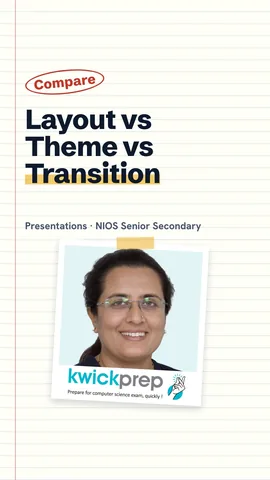
Slide layouts, design and transitions
A layout places boxes on one slide, a theme styles all slides, and a transition is the effect as the next slide appears.
Follows the syllabus of: NIOS Senior Secondary Data Entry Operations (336)
On screen in this lesson
Three tools, three jobs
| Layout: where things sit on one slide |
| Design: the look of all slides together |
| Transition: the effect between two slides |
What is a placeholder?
| A dotted box on a new slide |
| Click to add title, text or a picture |
| Layouts are made of placeholders |
Common slide layouts
| Layout | Placeholders | Best for |
|---|---|---|
| Title Slide | title, subtitle | first slide |
| Title and Content | title, one box | points or a chart |
| Two Content | title, two boxes | side by side |
| Comparison | two boxes, labels | pros and cons |
| Title Only | only a title | your own picture |
| Blank | none | full image |
Choosing a layout
| PowerPoint: Home tab, then Layout |
| Impress: Slide menu, then Layout |
| Pick a layout when you add a new slide |
| Change it later without losing text |
Example: a school annual day
| Slide 1: Title Slide with school name |
| Slide 2: Title and Content for the schedule |
| Slide 3: Comparison for last year and this year |
| Slide 4: Blank with a full group photo |
Slide design and themes
| A theme sets colours, fonts and background |
| PowerPoint: Design tab, pick a theme |
| Impress: master slides in the sidebar |
| One theme applies to every slide |
Quick answers
Is a transition the same as an animation?
No. A transition works between slides.
A transition is set on slide 3 only. Where do you see it?
When slide 3 comes in.
KwickClips from this lesson
Short clips, one idea each. Good for revision the night before.
The full lesson, in text
Hello students, welcome to Kwickprep. Why do some presentations look neat and professional, while others look messy? The secret is three tools. Today we will learn slide layouts, slide design and slide transitions, step by step.
Let us first see what each word means. A layout decides where the title, text and pictures sit on one slide. A design, also called a theme, gives all slides the same colours, fonts and background. A transition is the moving effect you see when one slide changes to the next.
Before layouts, one new term. There are dotted boxes on every new slide. Each dotted box is called a placeholder, because it holds a place ready for your content. You click inside it and type a title, text, or insert a picture. Every layout is simply a different arrangement of these placeholders.
Here are the layouts you will use most. Title Slide has a title and subtitle, so it suits the first slide. Title and Content has one big box for points, a table or a chart. Two Content gives two boxes side by side. Comparison adds a small label above each box, useful for pros and cons. Title Only keeps just the title, so you can place your own picture. Blank has no placeholders at all.
Now, how do we choose a layout? In Microsoft PowerPoint, go to the Home tab and click Layout. In LibreOffice Impress, open the Slide menu and choose Layout, or use the sidebar. You can also pick a layout while adding a new slide. You can change the layout later, and your typed text moves into the new placeholders.
Let us plan a small presentation for a school annual day. Slide one uses the Title Slide layout with the school name and date. Slide two uses Title and Content to list the event schedule. Slide three uses Comparison to show last year's results beside this year's. Slide four uses Blank, so a group photo can fill the whole slide.
Next, design. A theme is a ready set of colours, fonts and background that works well together. In PowerPoint, open the Design tab and click a theme. In Impress, choose a master slide from the sidebar, which does the same job. The theme applies to all slides at once, so the presentation looks like one family.
You can also change only the background. Format Background lets you use a plain colour, a gradient, or a picture. A gradient means one colour slowly blending into another. You may apply it to one slide or to all slides. The slide master is the main slide that stores the style for all slides. Change the font on the master once, and every slide changes.
A good design is easy to read from the last bench. Use dark text on a light background, or light text on a dark one. Use at most two fonts in the whole presentation. Keep about six points or fewer on each slide. Where possible, show a clear picture instead of a long paragraph.
Now, transitions. A transition is the effect you see when the presentation moves to the next slide. Common transitions are Fade, Push, Wipe and Cover. A transition is set on the slide that is coming in. Do not mix it up with an animation, which moves an object, like a picture, inside one slide.
Every transition has a few settings. The effect is the style, such as Fade. Duration is how long the change takes, like one second. Sound plays a short sound, but use it rarely. On mouse click waits until the speaker clicks. After a set time moves on by itself, useful at a stall or a notice screen. Apply to All gives every slide the same transition.
Here are the steps. In PowerPoint, select the slide, open the Transitions tab, and click an effect. In Impress, open Slide Transition in the sidebar and choose an effect. Then set the duration, and choose on mouse click or after a time. Finally, click Preview to watch it before you show your audience.
Pause and predict. You add a Fade transition only on slide three. Slides one, two and four have no transition. Where will the audience see the Fade? The answer is, when slide two changes to slide three, because the effect belongs to the slide coming in.
Let us revise what we learned today. A layout is the arrangement of placeholders on one slide. A theme gives all slides the same colours, fonts and background. The slide master lets you change the style once for every slide. A transition is the effect shown as the next slide comes in. And you can set its effect, duration, sound and advance timing.
Courses that teach this
| Course | Unit |
|---|---|
| NIOS Senior Secondary Data Entry Operations (336) | Lesson 9: Creating Presentation |
Free to watch, no sign-up. The live classes are the paid course; these lessons stay free either way.
Disclaimer. KwickAcademy is free study material for general learning and revision. Parts of it, including the voice-over, are produced with the help of AI tools and may contain errors; if you spot one, please tell us and we will correct it. Syllabus, marks and exam details follow the latest official board publications available to us, and boards can change them at any time, so always confirm against your board's official website and your school. Using this material does not guarantee any marks or result. Board names and trademarks belong to their owners; Kwickprep is not affiliated with or endorsed by any examination board. We never ask for passwords, OTPs or ID numbers. Your progress is saved only in this browser. Full disclaimer · Privacy