
KwickAcademy Networks and the Internet · 7 min · free
Network Topologies: Bus, Star, Ring, Tree and Mesh
Learn the five network topologies, what happens when a link fails in each, their advantages and drawbacks, and how to choose one. A topology is the layout in which nodes and links are connected.
Follows the syllabus of: CBSE Class 12 Computer Science (083), CBSE Class 12 Informatics Practices (065), CBSE Class 11 Information Technology (802), Edexcel GCSE GCSE Computer Science (1CP2)
On screen in this lesson
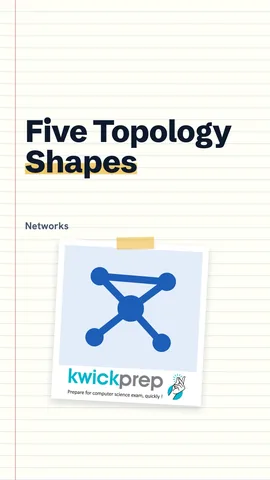
What is a topology?
| The layout of how nodes are connected |
| Node: any device on the network |
| Link: the cable or wireless path between nodes |
Bus topology
| All nodes join one main cable, the backbone |
| Terminators at both ends stop signals bouncing |
| Data travels along the cable to every node |
| Like houses along one village road |
Star topology
| Every node has its own cable to a central device |
| The centre is a hub or a switch |
| Most common layout in schools and offices |
| Like spokes joined at the centre of a wheel |
Ring topology
| Each node connects to exactly two neighbours |
| The links form a closed circle |
| Data goes around the ring, node to node |
| Like children passing a parcel in a circle |
Tree topology
| Star networks joined in levels, like branches |
| A root at the top links smaller stars below |
| Easy to grow by adding a new branch |
| Like a school: principal, departments, classes |
Mesh topology
| Nodes have many links, giving many paths |
| Full mesh: every node links to every other |
| Full mesh of n nodes needs n(n-1)/2 links |
| Like roads joining every city to every city |
Quick answers
In a star of 10 PCs, one cable is cut. How many can still talk?
9. Each PC has its own cable, so only the cut one is isolated.
How many links does a full mesh of 4 nodes need?
6, from n(n-1)/2.
KwickClips from this lesson
Short clips, one idea each. Good for revision the night before.
 What is a topology?43 sec
 Which topology survives a broken link best?43 sec
 Which topology uses the least cable?42 sec
 Which topology suits a school computer lab?41 sec
The full lesson, in text
Hello students, welcome to Kwickprep. In one office, a single broken cable stops every computer. In another office, nobody even notices. Why? The answer is topology. Today we will learn bus, star, ring, tree and mesh, what happens when a link fails, and how to choose one.
First, the meaning. A topology is the layout, or the shape, in which the devices of a network are connected. A node is any device on the network, like a computer or a printer. A link is the cable or wireless path joining two nodes. So topology is simply the pattern of nodes and links.
Let us draw the first shape, the bus. In a bus topology, every node is attached to one long main cable, called the backbone. A small device called a terminator sits at each end, so the signal does not bounce back. Data sent by one node travels along the whole cable, and every node sees it, but only the right node accepts it. Picture houses along one village road, all sharing the same road.
The second shape is the star. In a star topology, every node has its own separate cable to one central device. That central device is a hub or a switch, which passes data between nodes. This is the most common layout in school labs and offices today. Picture the spokes of a bicycle wheel, all meeting at the centre.
The third shape is the ring. In a ring topology, each node is connected to exactly two neighbours, one on each side. The links form a closed circle. Data travels around the ring from one node to the next, until it reaches the right one. Picture children in a circle playing passing the parcel.
The fourth shape is the tree, also called hierarchical topology. It joins several star networks in levels, like the branches of a tree. A central device at the top, the root, connects to smaller stars below it. To grow the network, you simply add a new branch. Picture a school: the principal at the top, then departments, then classes under each department.
The fifth shape is the mesh. In a mesh topology, nodes are joined by many links, so data has many possible paths. In a full mesh, every node is linked directly to every other node. Each of four computers links to the other three, that is twelve links. But each link is counted twice, so a full mesh of four needs six links. Picture roads that join every city directly to every other city.
Let us see all five together. Bus is one straight line, and everything depends on the backbone cable. Star looks like spokes, and depends on the hub or switch. Ring is a circle with no centre. Tree is branches, with a root device at the top. Mesh is a web of links, also with no centre.
Now the big question: what happens when something fails? If the backbone of a bus breaks, the whole bus network stops. In a star, one broken cable cuts off just one node. But if the central hub fails, the whole star stops. In a simple ring, one broken link stops data going around, so the ring stops. In a tree, a cut branch disconnects only the nodes below it. In a mesh, data simply takes another path, so the network keeps working.
Pause and predict. A star network has ten computers, and the cable of one computer is cut. How many computers can still talk to each other? The answer is nine, because in a star, each computer has its own cable, so only that one computer is cut off.
Now let us weigh advantages and disadvantages. A bus uses the least cable, so it is cheap, but a fault in the backbone stops everything. It is easy to add a node to a bus, but it slows down when many nodes send data. A star makes faults easy to find, but if the hub fails, the whole network fails. In a star, adding or removing a node is easy, but it needs more cable than a bus.
Here are the other three. A ring avoids data collisions, which means two signals clashing, because data moves in order, but one break can stop the whole ring. A tree is easy to expand branch by branch, but if the root fails, the branches cannot reach each other. A mesh is very reliable, because there are many paths, but it needs the most cable and is costly. Mesh links can also be private between two nodes, but setting it up is hard.
Now let us choose a topology for a situation. For a school computer lab, choose star, because faults are easy to find and computers are easy to add. For a small, temporary setup with little budget, a bus uses the least cable. For a company with many floors or departments, choose tree, because each floor becomes a branch. For links between bank data centres, choose mesh, because the network must never stop.
In exam case studies, ask three questions before choosing. First, how much money is available, because more cable costs more. Second, how many nodes are there, and will the network grow later? Third, how serious is a breakdown, since a hospital or bank cannot afford to stop.
Let us revise what we learned today. A bus uses one backbone, and a break in it stops everything. A star uses a central hub, and one cut cable affects only one node. A ring is a closed circle, where one break can stop the whole network. A tree joins stars in levels, and a cut branch is isolated from the rest. A mesh has many paths, so it is the most reliable, but also the most costly.
Courses that teach this
| Course | Unit |
|---|---|
| CBSE Class 12 Computer Science (083) | Computer Networks |
| CBSE Class 12 Informatics Practices (065) | Introduction to Computer Networks |
| CBSE Class 11 Information Technology (802) | Part B, Unit 2: Networking and Internet |
| Edexcel GCSE GCSE Computer Science (1CP2) | Topic 4: Networks |
Free to watch, no sign-up. The live classes are the paid course; these lessons stay free either way.
Disclaimer. KwickAcademy is free study material for general learning and revision. Parts of it, including the voice-over, are produced with the help of AI tools and may contain errors; if you spot one, please tell us and we will correct it. Syllabus, marks and exam details follow the latest official board publications available to us, and boards can change them at any time, so always confirm against your board's official website and your school. Using this material does not guarantee any marks or result. Board names and trademarks belong to their owners; Kwickprep is not affiliated with or endorsed by any examination board. We never ask for passwords, OTPs or ID numbers. Your progress is saved only in this browser. Full disclaimer · Privacy