
KwickAcademy Computer Science · 7 min · free
Software Licensing: Open Source, Free and Proprietary Software
A licence says how you may use software. Proprietary code is closed, free software gives four freedoms, and open source code is open to all. Freeware costs nothing but its code stays closed.
Follows the syllabus of: CBSE Class 10 Computer Applications (165), CBSE Class 11 Computer Science (083), CBSE Class 11 Computer Science Essentials (083), CBSE Class 12 Informatics Practices (065)
On screen in this lesson
What is a software licence?
| A legal permission from the owner |
| Says how you may use, copy or share software |
| You agree to it when you install |
| Breaking it is a violation of copyright |
Proprietary software
| Owned by a company; source code kept secret |
| Usually paid; you buy a licence to use it |
| You cannot change or share it |
| Examples: Microsoft Windows, MS Office, Photoshop |
Free software: free as in freedom
| Freedom to run the program for any purpose |
| Freedom to study and change the source code |
| Freedom to share copies |
| Freedom to share your improved version |
Open source software
| Source code is open for anyone to see |
| Anyone may use, change and share it |
| Built by communities of developers |
| Usually free of cost too |
Freeware is not free software
| Type | Costs money? | Code open? |
|---|---|---|
| Proprietary | usually yes | no |
| Freeware | no | no |
| Shareware | after trial | no |
| Free / open source | usually no | yes |
GPL: the copyleft licence
| GNU General Public License |
| Use, change and share freely |
| Shared changes must also be GPL |
| Called copyleft; used by Linux |
Quick answers
Is freeware the same as free software?
No. Freeware is free of cost but its code is closed.
What does copyleft mean in the GPL?
Shared changes must also be released under the GPL.
KwickClips from this lesson
Short clips, one idea each. Good for revision the night before.
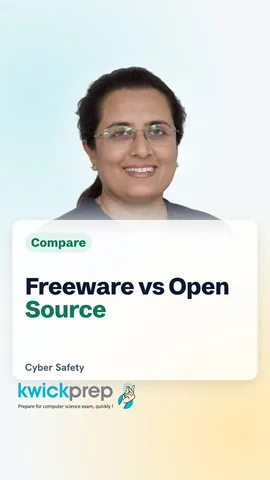 Does free software mean free of cost?40 sec
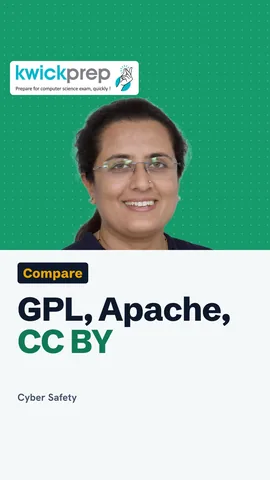 Which licence is copyleft?43 sec
 Can you use cracked software for a project?40 sec
 What can replace a paid image editor?42 sec
The full lesson, in text
Hello students, welcome to Kwickprep. Is free software the same as software you download without paying? Surprisingly, no. Today we will learn about software licences, the difference between proprietary, free and open source software, and why this matters for you.
First, a key term. A software licence is a legal permission given by the owner of the software. It says how you may use, copy, change or share that software. You usually agree to it when you click I agree during installation. If you break the licence, you violate the owner's copyright.
Proprietary software is owned by a person or company that keeps full control. Its source code, the human-readable program, is kept secret. Usually you pay for a licence, which lets you use it but not own it. You are not allowed to change it or share copies. Examples are Microsoft Windows, Microsoft Office and Adobe Photoshop.
Free software is about freedom, not price. The Free Software Foundation, started by Richard Stallman, lists four freedoms. The first is the freedom to run the program for any purpose. The second is the freedom to study how it works and change its source code. The third is the freedom to share copies with others. The fourth is the freedom to share your improved version, so everyone benefits.
Open source software is very close to free software. Its source code is open, so anyone can read it. Anyone may use it, change it and share it, following its licence. It is often built by large communities of developers around the world. Most open source software is also free of cost, so the two ideas are often written together as FOSS, free and open source software.
Students often mix up these words, so let us compare them. Proprietary software usually costs money, and its code is closed. Freeware costs nothing, but its code is still closed, so it is not free software. Shareware lets you try it free for a while, then asks you to pay. Free and open source software is usually free of cost, and its code is open.
Now, some famous licences. The GPL, or GNU General Public License, is the best known free software licence. It lets you use, study, change and share the software. But if you share a changed version, you must share it under the GPL too, with its source code. This rule is called copyleft, because it keeps the software free forever, and the Linux kernel uses it.
The Apache License is a permissive licence, which means it has very few conditions. You may use Apache code even inside a closed, paid product. You must keep the original copyright and licence notice. It also gives users a patent grant, so contributors cannot later sue users over patents in their code. Android and many big software projects use it.
Creative Commons licences are made for creative work like photos, music, videos and notes, not mainly for code. BY means attribution, so you must give credit to the creator. SA means share alike, so your new work must use the same licence. NC means non commercial, so you cannot use it to make money. ND means no derivatives, so you cannot change it. CC zero puts the work in the public domain, with no conditions at all.
Let us apply this to real choices. A photo under CC BY can go in your school video and even on a T-shirt you sell, if you give credit. A photo under CC BY NC can go in your school video with credit, but not on a T-shirt you sell. A photo under CC BY ND may be used only unchanged, so no cropping or editing. Pause and predict: can you edit a CC BY ND photo for your poster? No, ND means no changes.
Why should a student care about licences? Using cracked software is illegal, and it often carries malware. Your school projects must follow licences and credit any code or images you reuse. Free and open source tools give you legal, powerful software at no cost. And contributing to open source projects on sites like GitHub builds a portfolio that colleges and employers value.
Here are open source tools you can use today. Ubuntu Linux is a complete operating system that can replace Windows. LibreOffice gives you a word processor, spreadsheet and presentation program, like Microsoft Office. Firefox is an open source web browser, an alternative to Chrome. GIMP edits images, much like Photoshop. And Python, the language many of you study, is open source too, and is often used in place of paid tools like MATLAB.
There are many more examples. VLC media player plays almost any audio or video file. Android is built on open source code, although phones also include closed Google apps. MySQL is a popular database, and the Apache web server runs a large number of websites. BOSS Linux is an Indian open source operating system developed by C-DAC.
Let us revise what we learned today. Proprietary software has closed code and is usually paid. Free software gives four freedoms, while freeware is only free of cost. Open source software lets anyone use, change and share its code. The GPL is copyleft, Apache is permissive, and Creative Commons is for creative work. Always use licensed or open source tools, and give credit.
Courses that teach this
| Course | Unit |
|---|---|
| CBSE Class 10 Computer Applications (165) | Cyber ethics |
| CBSE Class 11 Computer Science (083) | Society, Law and Ethics |
| CBSE Class 11 Computer Science Essentials (083) | Society, Law and Ethics |
| CBSE Class 12 Informatics Practices (065) | Societal Impacts |
| ICSE Class 9 Computer Applications | Computing and Ethics |
| ISC Class 11 Computer Science (868) | Social Context of Computing |
| GSEB Std 12 Computer Studies | Document Publishing and Free Tools |
| NIOS Senior Secondary Computer Science (330) | Module 2: Office Automation |
Free to watch, no sign-up. The live classes are the paid course; these lessons stay free either way.
Disclaimer. KwickAcademy is free study material for general learning and revision. Parts of it, including the voice-over, are produced with the help of AI tools and may contain errors; if you spot one, please tell us and we will correct it. Syllabus, marks and exam details follow the latest official board publications available to us, and boards can change them at any time, so always confirm against your board's official website and your school. Using this material does not guarantee any marks or result. Board names and trademarks belong to their owners; Kwickprep is not affiliated with or endorsed by any examination board. We never ask for passwords, OTPs or ID numbers. Your progress is saved only in this browser. Full disclaimer · Privacy