

KwickAcademy Python · 7 min · free
Function Arguments: Positional, Default and Keyword Parameters
Learn Python function arguments for CBSE Class 12: parameters vs arguments, positional, default, keyword, order rules, errors. A parameter is the name in the def line; an argument is the actual value sent in the call.
Follows the syllabus of: CBSE Class 12 Computer Science (083)
On screen in this lesson
Parameters vs arguments
| Term | Where it is | Example |
|---|---|---|
| Parameter | In the def line | name, amount |
| Argument | In the call | "Riya", 199 |
| Also called | formal / actual | same idea |
The three kinds together
| Kind | Written where | Example |
|---|---|---|
| Positional | In the call | ticket("Aman", 15) |
| Default | In the def line | qty=1 |
| Keyword | In the call | age=15 |
Order rules
| In a call: positional first, then keyword |
| In def: parameters without defaults come first |
| Each parameter gets only one value |
| Every parameter without a default must get a value |
| Do not send more arguments than parameters |
Common errors: fee(amt, gst)
| Mistake | Error | Why |
|---|---|---|
| fee(9) | TypeError | gst is missing |
| fee(9, 1, 2) | TypeError | too many values |
| fee(9, amt=1) | TypeError | amt got two |
| fee(amt=9, 1) | SyntaxError | keyword first |
| def g(a=1, b): | SyntaxError | default first |
Quick recap
| Parameters are in def; arguments are in the call |
| Positional: matched by order |
| Default: used when no value is given |
| Keyword: name=value, any order |
| Positional before keyword; no list defaults |
Quick answers
What does "missing 1 required positional argument" mean?
A parameter without a default got no value in the call.
Can a keyword argument come before a positional one in a call?
No. That gives a SyntaxError. Positional comes first.
KwickClips from this lesson
Short clips, one idea each. Good for revision the night before.
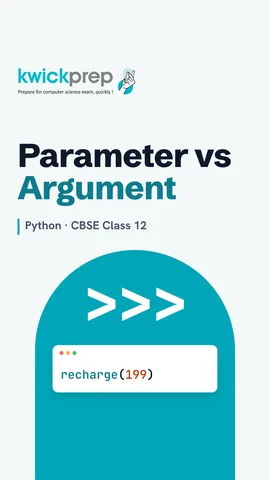 Are parameters and arguments the same?39 sec
 What happens if qty is missing?41 sec
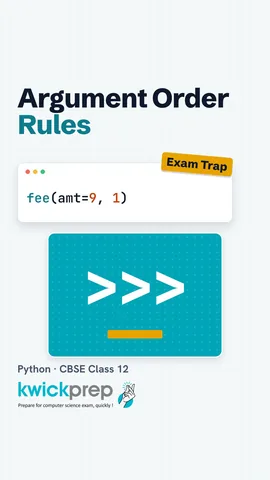 Why is fee(amt=9, 1) an error?40 sec
![Code with def add(x, bag=[]) where the second call prints pen and book together.](/images/learn/clips/PY20-R4.webp) Why does the old item stay in a list default?42 sec
Why does the old item stay in a list default?42 secThe full lesson, in text
Hello students, welcome to Kwickprep. Have you seen Python say, missing one required positional argument? What does that mean, and how do you fix it? Today we will learn positional, default and keyword arguments, the order rules, and one famous trap.
First, a quick reminder. A function is a named block of code, made with the keyword def. Writing its name with round brackets is a call, and a call runs it. This recharge function takes a name and an amount. The call gives Riya and one hundred ninety nine, so it prints Riya paid one hundred ninety nine.
Two words sound alike, but they are different. A parameter is the variable name written in the def line, like name and amount. An argument is the actual value sent in the call, like Riya and one hundred ninety nine. Some books call parameters formal parameters and arguments actual parameters. Think of a parameter as an empty box, and the argument as what you put inside.
Positional arguments are matched by their position, which means their order. The first argument goes to the first parameter, and the second goes to the second. In the first call, name gets Aman and age gets fifteen. In the second call, we swapped the order. Python does not complain, but it prints fifteen is Aman, which is wrong. So with positional arguments, order matters.
A default argument is a value written in the def line, which is used when the call gives nothing. At a canteen, most people order just one item. So the parameter qty, short for quantity, has a default of one. The first call gives only samosa, so qty uses one. The second call gives three, so three replaces the default.
A keyword argument names the parameter in the call. We write the parameter name, an equals sign, and the value. Here this equals sign does not compare anything. It simply says which parameter gets which value. Now the order does not matter. Age is written first, yet the output is correct, Aman is fifteen.
Let us put the three kinds side by side. Positional arguments are matched by order, in the call. Default values are written in the def line, and they fill in when a value is missing. Keyword arguments use the parameter name in the call, so order does not matter.
Python has strict order rules. In a call, positional arguments must come before keyword arguments. In a def line, parameters without a default must come before parameters with a default. Each parameter can receive only one value. Every parameter without a default must receive a value. And you cannot send more arguments than there are parameters.
Here, the function fee has two parameters, amt for the amount and gst for the tax, and each row breaks one rule. Calling fee with only one value gives a type error. Python says, missing one required positional argument, because gst got no value. Sending three values also gives a type error, because there are only two parameters. Sending nine by position and then amt equals one gives amt two values, so again a type error. Putting a keyword argument before a positional one gives a syntax error. In the last def line, a default parameter comes before a plain one, which is also a syntax error.
Now all three kinds work together in a shop bill. The parameter off is the discount in rupees. Bill of fifty uses both defaults, so it returns fifty. Bill of fifty and four gives four items, so two hundred. The third call skips qty and uses a keyword for off, so fifty minus ten is forty. Pause and predict. What does bill of fifty, with qty equal to zero, print?
Here is that call, so you can check your answer. Qty is zero, so price times qty is zero. The discount is also zero by default. So it prints zero, not fifty.
Board exams often ask output questions such as this. Remember, multiply happens before add. In the first call, runs is one and both defaults are used, so one plus two times three is seven. In the second call, times becomes ten, so one plus twenty is twenty one. In the third call, both are keywords, so five plus zero times three is five.
This part is for advanced courses. A list is mutable, which means it can be changed after it is made. Append adds an item to the end of a list. We expect each call to start with an empty bag. But the second call prints pen and book together. Why? The default list is made only once, when the def line runs, and every call shares it.
The safe way is to use None as the default. None is a special value that means nothing. The is operator checks whether bag is exactly None. If it is, we make a fresh empty list inside the function. Now every call gets its own new bag, so pen and book stay apart.
Let us revise what we learned today. Parameters are written in the def line, and arguments are the values in the call. Positional arguments are matched by order. Default values are used when the call gives no value. Keyword arguments use the parameter name, so any order works. Keep positional before keyword, and never use a list as a default value.
Courses that teach this
| Course | Unit |
|---|---|
| CBSE Class 12 Computer Science (083) | Computational Thinking and Programming – 2 |
| Programming All levels Python | Functions |
Free to watch, no sign-up. The live classes are the paid course; these lessons stay free either way.
Disclaimer. KwickAcademy is free study material for general learning and revision. Parts of it, including the voice-over, are produced with the help of AI tools and may contain errors; if you spot one, please tell us and we will correct it. Syllabus, marks and exam details follow the latest official board publications available to us, and boards can change them at any time, so always confirm against your board's official website and your school. Using this material does not guarantee any marks or result. Board names and trademarks belong to their owners; Kwickprep is not affiliated with or endorsed by any examination board. We never ask for passwords, OTPs or ID numbers. Your progress is saved only in this browser. Full disclaimer · Privacy