

KwickAcademy Computer Systems · 8 min · free
Boolean Algebra: Laws and Theorems
Learn Boolean variables and operators, the main Boolean laws, De Morgan's theorems and step-by-step simplification. In Boolean algebra, + means OR, so 1 + 1 = 1.
Follows the syllabus of: CBSE Class 11 Computer Science (083), CBSE Class 11 Computer Science Essentials (083), ISC Class 12 Computer Science (868)
On screen in this lesson
Boolean variables
| A Boolean variable holds only 0 or 1 |
| 1 means True, 0 means False |
| Named George Boole, a 19th century mathematician |
| Examples: A = light on, B = door open |
Boolean operators
| Operator | Written | Spoken |
|---|---|---|
| NOT | A' | not A, A bar |
| AND | A.B | A and B |
| OR | A+B | A or B |
Order of operations
| First: brackets |
| Then NOT |
| Then AND |
| Last: OR |
Identity and null laws
| Law | OR form | AND form |
|---|---|---|
| Identity | A+0 = A | A.1 = A |
| Null | A+1 = 1 | A.0 = 0 |
| Complement | A+A' = 1 | A.A' = 0 |
| Involution | (A')' = A | one form only |
Idempotence and order
| Law | OR form | AND form |
|---|---|---|
| Idempotence | A+A = A | A.A = A |
| Commutative | A+B = B+A | A.B = B.A |
| Associative | A+(B+C)=(A+B)+C | A.(B.C)=(A.B).C |
Distributive law
| Form | Left side | Right side |
|---|---|---|
| AND over OR | A.(B+C) | A.B + A.C |
| OR over AND | A+B.C | (A+B).(A+C) |
Quick answers
Simplify (A.B.C)'.
A' + B' + C'.
What is A' + A.B simplified?
A' + B.
KwickClips from this lesson
Short clips, one idea each. Good for revision the night before.
 What values can a Boolean variable hold?43 sec
 What is A + A.B?46 sec
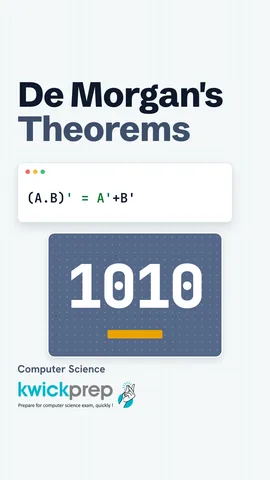 What is (A.B)'?38 sec
 What is B + B'?39 sec
The full lesson, in text
Hello students, welcome to Kwickprep. A long logic expression means many gates, more cost and more heat. Can we make it shorter without changing its output? Yes, with Boolean algebra. Today we learn Boolean variables, the main laws, De Morgan's theorems, and how to simplify step by step.
First, what is a Boolean variable? It is a variable that can hold only one of two values, zero or one. One means True and zero means False. The name comes from George Boole, a mathematician who wrote about this logic in the eighteen hundreds. For example, A can mean the light is on, and B can mean the door is open.
Boolean algebra has three basic operators. NOT is written with a prime mark or a bar over the letter, and we read A prime as not A. AND is written with a dot, like multiplication, and we read it as A and B. OR is written with a plus sign, and we read it as A or B. Remember, this plus is not ordinary addition: one plus one is one here.
Like BODMAS in maths, Boolean algebra has an order. Brackets are worked out first. Next comes NOT. Then comes AND. OR comes last, so A plus B dot C means A plus, in brackets, B dot C.
Now the laws, each with an OR form and an AND form. The identity law says A plus zero is A, and A dot one is A, so zero and one leave A unchanged. The null law says A plus one is always one, and A dot zero is always zero. The complement law says A plus not A is one, and A dot not A is zero. Involution says not of not A is A again. Check any law by putting A equal to zero and then one.
Next come three more laws. Idempotence means repeating a variable changes nothing: A plus A is A, and A dot A is A. The commutative law says the order does not matter: A plus B equals B plus A. The associative law says grouping does not matter for the same operator. A plus, in brackets, B plus C equals A plus B, in brackets, plus C, and the same is true for dot.
The distributive law opens brackets. The first form is just like ordinary algebra: A dot, B plus C, equals A dot B plus A dot C. The second form has no match in ordinary algebra: A plus B dot C equals A plus B, dot, A plus C. Students often forget this second form, so learn it well.
The absorption law lets a term swallow a bigger term. A plus A dot B is just A. A dot, A plus B, is also just A. Here is a proof of the OR form. Write A as A dot one, and take A common to get A dot, one plus B. One plus B is one, so the answer is A. Think of it this way: if A is one, the whole thing is one, and if A is zero, both terms are zero.
De Morgan's theorems tell us how to open a NOT over a bracket. The first theorem says not of A plus B equals not A dot not B. The second theorem says not of A dot B equals not A plus not B. The easy rule is: break the bar, and change the sign, so plus becomes dot and dot becomes plus.
Exams often ask you to prove De Morgan's theorem with a truth table. Row one: A plus B is zero, so its complement is one. Not A dot not B is one dot one, which is also one. Row two: A plus B is one, so its complement is zero, and one dot zero is zero. Row three: again both columns are zero. Row four: both columns are zero. The two columns match in every row, so the theorem is proved.
Pause the video and try this one. Simplify not of A dot B dot C. Use the hint, break the bar and change the sign. The answer is not A plus not B plus not C, because De Morgan works for any number of variables.
Now let us simplify step by step, writing the law at each step. Step one: we start with A dot B plus A dot not B. Step two: take A common, which gives A dot, B plus not B, by the distributive law. Step three: B plus not B is one, by the complement law. Step four: A dot one is A, by the identity law. Four gates became zero gates, just a wire from A.
Here is a second example. Step one: we start with A plus B, dot, A plus not B. Step two: use the second distributive form backwards, to get A plus B dot not B. Step three: B dot not B is zero, by the complement law. Step four: A plus zero is A, by the identity law.
One more, which appears often in exams. Step one: the expression is not A plus A dot B. Step two: use the distributive law A plus B dot C, which gives not A plus A, dot, not A plus B. Step three: not A plus A is one, by the complement law. Step four: one dot anything is that thing, so the answer is not A plus B.
Let us revise what we learned today. A Boolean variable holds only zero or one, and the operators are NOT, AND and OR. Identity, null, complement and idempotence handle zero, one and repeated variables. Commutative, associative, distributive and absorption let us reorder, regroup and shrink terms. De Morgan says break the bar and change the sign. When you simplify, write one step per line and name the law, because marks are given for each step.
Courses that teach this
| Course | Unit |
|---|---|
| CBSE Class 11 Computer Science (083) | Computer Systems and Organisation |
| CBSE Class 11 Computer Science Essentials (083) | Computer Systems and Organisation |
| ISC Class 12 Computer Science (868) | Boolean Algebra |
Voice-over in this lesson is AI-generated. The script is written and checked by Kajal Ma'am. Boards can revise a syllabus mid-year, so confirm anything you plan around against the official board circular. Keep your passwords, OTPs and ID numbers to yourself — we never ask for them. To reach Kajal Ma'am, use the WhatsApp button; sharing your number there is how we call you back.
Free to watch, no sign-up. Live classes with Kajal Ma'am are the paid course; these lessons stay free either way.