

KwickAcademy Computer Science · 8 min · free
Cyber Crime: Hacking, Phishing, Cyber Bullying and Cyber Stalking
Cyber crime uses a computer, phone or internet as the tool or the target. Hacking, phishing, bullying, DoS and brute force are all covered by law. In India, report at cybercrime.gov.in or call 1930 for money fraud.
Follows the syllabus of: CBSE Class 9 Computer Applications (165), CBSE Class 12 Informatics Practices (065), CBSE Class 11 Information Technology (802), Cambridge IGCSE Grade 9 Computer Science (0478)
On screen in this lesson
What is cyber crime?
| A crime that uses a computer, phone or internet |
| Device as the tool: fraud messages |
| Device as the target: breaking into a server |
| Covered by the IT Act, 2000 and other laws |
Hacking
| Hacker | Intent | Status |
|---|---|---|
| Black hat | Steal or damage | Illegal |
| White hat | Test with consent | Legal |
| Grey hat | Break in, report | Illegal |
Eavesdropping
| Secretly capturing data as it travels |
| Common on open public Wi-Fi |
| Unencrypted data can be read |
| Fake free Wi-Fi hotspots collect your data |
| Avoid banking on public Wi-Fi |
Phishing
| Fake message that steals personal details |
| Pretends to be a bank, courier or school |
| Creates urgency or fear |
| Link leads to a look-alike website |
| By SMS: smishing; by phone call: vishing |
Spot the red flags
| Check | Red flag |
|---|---|
| Sender domain | Not official |
| Greeting | Dear Customer |
| Deadline | 24 hours, panic |
| Link | Look-alike site |
| Asks for | Password or OTP |
Trolls, bullying and stalking
| Behaviour | Meaning |
|---|---|
| Troll | Provoking comments |
| Bullying | Repeated harm |
| Stalking | Following, threats |
Quick answers
A bank email asks for your password and OTP. What is it?
Phishing. Real banks never ask for an OTP.
Where do you report money lost to online fraud?
Call 1930 or file at cybercrime.gov.in.
KwickClips from this lesson
Short clips, one idea each. Good for revision the night before.
 Is white hat hacking legal?37 sec
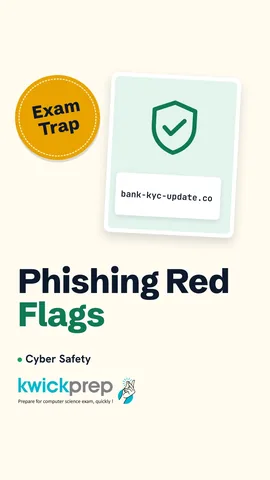 Do real banks ask for an OTP?41 sec
 Should you reply to a troll?41 sec
 What does a DoS attack do?38 sec
 Which helpline is for online money fraud in India?36 sec
The full lesson, in text
Hello students, welcome to Kwickprep. You get an email saying your bank account will be blocked today. It looks real, but is it? Today we will learn about hacking, eavesdropping, phishing and pharming. We will also study cyber bullying, stalking, denial of service and brute force attacks. Finally, we will learn how to report cyber crime in India.
First, the meaning. Cyber crime is any crime that uses a computer, phone or the internet. The device may be the tool, such as sending fraud messages. Or the device may be the target, such as breaking into a server. In India, many cyber crimes are punishable under the Information Technology Act, 2000, along with other criminal laws.
Hacking means gaining access to a computer or account without permission. Black hat hackers break in to steal or damage, and this is a crime. White hat hackers, also called ethical hackers, test systems with the owner's permission to find weaknesses. Grey hat hackers break in without permission but may not mean harm, and this is still illegal.
Now let us look at eavesdropping. Eavesdropping means secretly listening to or reading data while it travels over a network. It is common on open public Wi-Fi, such as at railway stations or cafes. An attacker on the same network can capture data that is not encrypted. A fake hotspot with a free Wi-Fi name can collect everything you send. So avoid banking on public Wi-Fi, and look for H T T P S.
Phishing is the commonest online fraud in India. Phishing is a fake message that tricks you into giving personal details. It pretends to come from a bank, a delivery company or even your school. It creates urgency, such as, your account will be blocked today. It contains a link to a fake website that looks real. Similar tricks by S M S are called smishing, and by phone calls, vishing.
Here is a fraud email built to look real. The sender's address ends in a strange domain, not the bank's real domain. It says Dear Customer, not your name. It creates panic about your K Y C, which means the identity check banks do. The link does not go to the real bank website. Real banks never ask you to update K Y C through such links.
Let us list the red flags in that email. First, the sender domain is not the bank's official domain. Second, the greeting is general, not your name. Third, the deadline creates panic. Fourth, the link points to a look alike address. Fifth, it asks for your password or O T P, which no real bank ever does.
Pharming is sneakier than phishing, because you do not even click a bad link. First, malware changes a setting on your computer, or an attacker corrupts the address lookup system. You type the correct bank address yourself. But you are secretly sent to a fake copy of the website. You enter your password there. The attacker now has your login details.
Now, crimes that target people. A cyber troll posts insulting or provoking comments to upset people and start fights. Cyber bullying means repeatedly harming someone online, such as spreading rumours, sharing embarrassing photos or excluding them from groups. Cyber stalking means repeatedly following, watching or threatening a person online. Stalking can be very frightening, and it is a serious crime.
If someone bullies, trolls or stalks you, here is what to do. Do not reply or fight back, because that is what they want. Take screenshots with the date and time as evidence. Block and report the account on the platform. Tell a parent, teacher or trusted adult right away. Report serious cases to the police or the cyber crime portal.
A denial of service attack stops real users from using a website. First, the attacker controls thousands of infected devices, called a botnet. All of them send huge numbers of requests to one server at the same time. The server cannot handle so many requests. Real users, such as students checking results, cannot open the site. When many devices attack together, it is called a distributed denial of service attack.
Now let us see how passwords are broken. A brute force attack tries every possible password until one works. Programs can try millions of guesses very quickly. A four digit pin has only ten thousand combinations, so it falls fast. A long password with mixed characters takes far longer. Defences include long passwords, locking the account after a few wrong tries, and two factor authentication.
Pause and predict. Which attack is it? A bank website cannot open because millions of fake requests hit it, so it is denial of service. Someone tries thousands of passwords on one account, so it is brute force. You type the right address but land on a fake site, so it is pharming. An S M S asks you to click to claim a refund, so it is smishing.
Now, how to report cyber crime in India. The National Cyber Crime Reporting Portal is cybercrime dot gov dot in. For money lost to online fraud, call the helpline one nine three zero immediately, because quick reporting can help freeze the money. Suspected fraud calls and messages can be reported on the Chakshu facility of the Sanchar Saathi portal. You can also go to your nearest police station or cyber cell.
A good report helps the police act quickly. Report as soon as possible, especially if money is lost. Keep screenshots, links, phone numbers and email addresses as evidence. Note transaction numbers and bank details for fraud cases. Do not delete the messages or chats. Women and children can report sensitive cases, and the portal has an option to report them anonymously.
Let us revise what we learned today. Hacking is entry without permission, and eavesdropping is secretly capturing data. Phishing uses fake messages, while pharming redirects you to fake sites. Trolls provoke, bullies repeatedly harm, and stalkers follow and threaten. Denial of service floods a server, and brute force tries every password. Report cyber crime at cybercrime dot gov dot in or call one nine three zero.
Courses that teach this
| Course | Unit |
|---|---|
| CBSE Class 9 Computer Applications (165) | Cyber-safety |
| CBSE Class 12 Informatics Practices (065) | Societal Impacts |
| CBSE Class 11 Information Technology (802) | Part B, Unit 2: Networking and Internet |
| Cambridge IGCSE Grade 9 Computer Science (0478) | 5. The Internet and Its Uses |
Voice-over in this lesson is AI-generated. The script is written and checked by Kajal Ma'am. Boards can revise a syllabus mid-year, so confirm anything you plan around against the official board circular. Keep your passwords, OTPs and ID numbers to yourself — we never ask for them. To reach Kajal Ma'am, use the WhatsApp button; sharing your number there is how we call you back.
Free to watch, no sign-up. Live classes with Kajal Ma'am are the paid course; these lessons stay free either way.