
KwickAcademy Cyber Safety and Ethics · 7 min · free
Pointers in C++
Plays from our YouTube channel. Watch on YouTube
A C++ pointer stores an address: & gives the address, * gives the value there, new takes memory and delete frees it.
Follows the syllabus of: NIOS Senior Secondary Computer Science (330)
On screen in this lesson
Memory and addresses
| RAM is a long row of numbered boxes |
| Each box number is an address |
| A variable lives at some address |
| & gives the address of a variable |
What is a pointer?
| A pointer stores the address of a variable |
| Declare: int *p; |
| Store an address: p = &marks; |
| * before p reads the value there |
& and * together
| Expression | Means | Value here |
|---|---|---|
| marks | the value | 80 |
| &marks | its address | like 0x7ffd |
| p | address stored | same as &marks |
| *p | value at p | 80 |
Dynamic memory: new
| Static memory: size fixed while compiling |
| new: takes memory while the program runs |
| int *p = new int; |
| int *a = new int[n]; |
Match new with delete
| Taken with | Free with | Example |
|---|---|---|
| new int | delete | delete p; |
| new int[n] | delete[] | delete[] a; |
| forgot delete | memory leak | bug |
The this pointer
| Every member function gets a hidden pointer |
| this holds the address of the calling object |
| Use this->x when a parameter has the same name |
| Static functions do not get this |
Quick answers
If int a = 5; int *p = &a; *p = *p + 10; what is a?
15, because *p is a itself.
How do you free new int[n]?
delete[].
KwickClips from this lesson
Short clips, one idea each. Good for revision the night before.
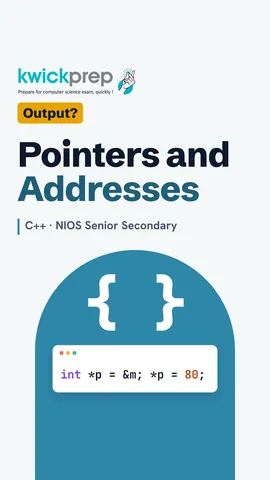 What does &m give?41 sec
![C++ code int *m = new int[2]{7, 9}; output 16; delete[] m;](/images/learn/clips/CP11-R2.webp) What pairs with new int[n]?40 sec
What pairs with new int[n]?40 sec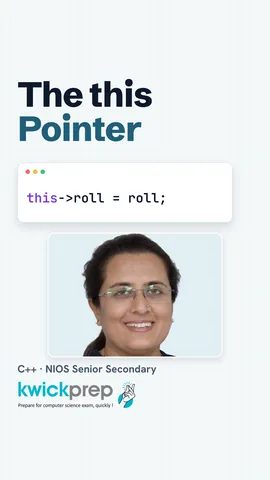 What does this hold?39 sec
 How should a pointer start?42 sec
The full lesson, in text
Hello students, welcome to Kwickprep. Your friend asks where you live, and you give your house address, not the house. A pointer does the same for data. Today we learn addresses and pointers, new and delete, pointers to objects, the this pointer, and the pointer bugs that crash programs.
First, how memory works. RAM is like a long row of boxes, one after another. Each box has a number, called its address. When we declare a variable, it is stored at some address. The ampersand sign, placed before a variable, gives its address, and it is called the address of operator.
Now let us meet the pointer itself. A pointer is a variable that stores the address of another variable. We declare it with a star, like int star p, which means p can point to an int. Then p equals ampersand marks stores the address of marks in p. Writing star p gives the value stored at that address, and this star is called the dereference operator.
Let us see it work. Marks is seventy two. The pointer p stores the address of marks. Now star p equals eighty means, go to the address in p and store eighty there. That address belongs to marks. So marks has changed, and it prints eighty, even though we never wrote marks equals eighty.
Let us put these side by side. Marks gives the value, eighty. Ampersand marks gives its address, which is a hexadecimal number that changes each run. P holds that same address. Star p goes to that address, and gives eighty. Exams often ask you to predict these four.
Now, memory while the program runs. Normally, variable sizes are fixed when the program is compiled. Sometimes we know the size only at run time, like the number of students in a class. The new operator takes memory while the program runs, and gives back its address. New int gives space for one integer, and new int with n in square brackets gives an array of n integers.
Here n is three students, and m points to their marks. New int of n makes an array of three integers, filled with seventy, eighty five and ninety. We use m like a normal array, and the total prints two hundred forty five. Memory from new is not freed by itself. So we free it with delete, using square brackets because it was an array.
Always match new with the right delete. Memory from new int is freed with delete. Memory from new with square brackets is freed with delete square brackets. If we forget to delete, that memory stays taken until the program ends, and this bug is called a memory leak.
A pointer can also point to an object. New Acc creates a bank account object, and p stores its address. To reach a member through a pointer, we use the arrow operator, a minus sign and a greater than sign. P arrow bal is the same as star p in brackets, dot bal. We add one hundred, so it prints six hundred, and then we delete the object.
Inside a member function, how does the function know which object called it? Every non static member function receives a hidden pointer named this. The this pointer holds the address of the object that called the function. It is useful when a parameter has the same name as a data member. Static member functions belong to the class, not an object, so they have no this pointer.
Here the parameter and the data member are both named roll. Inside set, plain roll means the parameter. This arrow roll means the data member of the object. So this arrow roll equals roll copies twelve into the object s. Then main prints s dot roll, which is twelve.
Pointers are powerful, but mistakes can crash a program. A wild pointer is declared but never given an address, so it points anywhere. Dereferencing a null pointer, which points to nothing, usually crashes the program. A dangling pointer still holds an address after that memory was deleted. A memory leak happens when memory from new is never deleted. And deleting the same memory twice is also a serious bug.
Here are safe habits in one program. We take memory with new, holding forty five, and free it with delete. Then we set p to nullptr, the keyword for a pointer to nothing, so it cannot dangle. A pointer you cannot fill yet should also start as nullptr. Before using star p, check whether p is null. P is null here, so it prints Empty.
Pause and predict. A is five. The pointer p stores the address of a. Then star p equals star p plus ten. What is a now? The answer is fifteen, because star p is a itself.
Let us revise what we learned today. The ampersand gives an address, and the star gives the value at an address. New takes memory at run time, and delete gives it back. Use delete with square brackets for arrays. The arrow reaches members through a pointer, and this points to the calling object. Always start pointers as nullptr, and avoid wild, dangling and null pointer bugs.
Courses that teach this
| Course | Unit |
|---|---|
| NIOS Senior Secondary Computer Science (330) | Module 3: Programming in C++ |
| Programming All levels C | Structures, Unions, and Enums |
| Programming All levels C++ | Arrays, Strings and Pointers |
Free to watch, no sign-up. The live classes are the paid course; these lessons stay free either way.
Disclaimer. KwickAcademy is free study material for general learning and revision. Parts of it, including the voice-over, are produced with the help of AI tools and may contain errors; if you spot one, please tell us and we will correct it. Syllabus, marks and exam details follow the latest official board publications available to us, and boards can change them at any time, so always confirm against your board's official website and your school. Using this material does not guarantee any marks or result. Board names and trademarks belong to their owners; Kwickprep is not affiliated with or endorsed by any examination board. We never ask for passwords, OTPs or ID numbers. Your progress is saved only in this browser. Full disclaimer · Privacy