
KwickAcademy Course Topics · 7 min · free
Computer Fundamentals
A computer takes input, processes it, gives output and stores it. It has input, CPU, memory and output units. RAM is volatile; ROM and storage keep data when power is off.
Follows the syllabus of: NIOS Senior Secondary Computer Science (330)
On screen in this lesson
What is a computer?
| An electronic machine |
| Takes data as input |
| Processes it using instructions |
| Gives information as output and stores it |
Characteristics of a computer
| Speed: millions of steps each second |
| Accuracy: no mistakes if data is right |
| Diligence: never tired or bored |
| Storage and versatility: many kinds of work |
| No IQ: cannot think or decide on its own |
Parts of a computer
| Unit | Job | Example |
|---|---|---|
| Input unit | feeds data in | keyboard, mouse |
| CPU | processes data | processor chip |
| Memory unit | holds data | RAM, SSD |
| Output unit | shows results | monitor, printer |
Inside the CPU
| Part | Full name | Job |
|---|---|---|
| ALU | arithmetic logic | calculate, compare |
| CU | Control Unit | directs all units |
| Registers | small fast memory | holds current data |
Primary and secondary memory
| Feature | Primary | Secondary |
|---|---|---|
| Examples | RAM, ROM | HDD, SSD, pen drive |
| Speed | very fast | slower |
| Size | smaller | much larger |
| Power off | RAM is erased | data stays |
| Cost per GB | higher | lower |
RAM and ROM
| RAM: random access memory |
| RAM is volatile: erased when power is off |
| ROM: read only memory |
| ROM is non-volatile: keeps startup instructions |
Quick answers
Power goes off before you save. Is the letter safe?
No. Unsaved work is in RAM, which is erased.
How many bits make a byte?
8 bits.
KwickClips from this lesson
Short clips, one idea each. Good for revision the night before.
The full lesson, in text
Hello students, welcome to Kwickprep. A computer can add a crore numbers in a second, yet it cannot think on its own. So what exactly is a computer? Today we will learn its parts, how it works, memory, and software.
A computer is an electronic machine that works under the control of instructions. It takes data as input. Data means raw facts, like the marks of forty students. It processes that data using a set of instructions called a program. It gives useful information as output, like the class average, and it can store the result.
This working is called the input, process, output cycle. First, input: the marks are typed on the keyboard. Next, process: the computer calculates the average. Then output: the result appears on the screen. Finally, storage: the result is saved in a file for later use.
Computers have some special qualities. Speed means it does millions of steps every second. Accuracy means it makes no mistakes, if the data and program are correct. Diligence means it never gets tired or bored, even after hours. It stores huge data and does many kinds of work, from billing to movies. But it has no IQ, meaning it cannot think on its own.
Every computer has four main units. The input unit feeds data into the computer, through a keyboard, mouse or scanner. The CPU, the central processing unit, does the actual processing. The memory unit holds data and programs. The output unit shows or prints the results, through a monitor, speaker or printer.
The CPU is called the brain of the computer, and it has three parts. The arithmetic logic unit does calculations like adding, and comparisons like greater than. The control unit is like a class monitor, directing all other units and deciding what happens next. Registers are tiny, very fast memory places inside the CPU that hold the data being worked on right now.
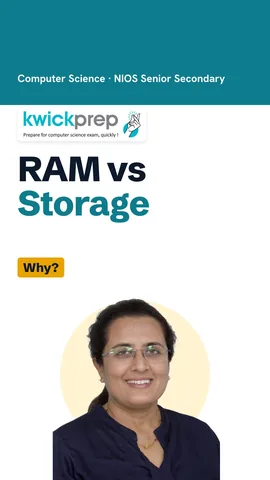
Memory is of two types. Primary memory includes RAM and ROM, while secondary memory includes hard disks, SSDs and pen drives. Primary memory is very fast, and secondary memory is slower. Primary memory is smaller, and secondary memory is much larger. When power goes off, RAM is erased, but secondary memory keeps the data. Primary memory also costs more for each gigabyte.
Let us look closer at primary memory. RAM stands for random access memory, where programs you are using right now are kept. RAM is volatile, which means its contents are lost when the power goes off. ROM stands for read only memory. ROM is non-volatile, so it keeps the startup instructions even without power.
Memory is measured in units. A bit is the smallest unit, and it is either zero or one. Eight bits make one byte, which can store one letter. One kilobyte is one thousand twenty four bytes. One megabyte is one thousand twenty four kilobytes, about a phone photo. One gigabyte is one thousand twenty four megabytes, about a movie. One terabyte is one thousand twenty four gigabytes.
Now two important words. Hardware means the physical parts you can touch, like the keyboard and monitor. Software means the programs that tell the hardware what to do. Hardware without software is useless, and software cannot run without hardware. Think of hardware as the body, and software as the knowledge that guides it.
Software is of several kinds. System software runs the computer itself, and the operating system is the main example. Application software does a task for the user, like typing a letter or making a bill. Utility software looks after the computer, like an antivirus or a backup tool. A language translator, such as a compiler, turns program code into zeros and ones.
The operating system, or OS, is the most important system software. It manages the CPU, the memory and the files. It controls input and output devices like the printer. It gives us a user interface, so we can click icons instead of typing hard commands. Examples are Windows, Linux, Android and macOS.
Pause and predict. You type a letter for two hours in a word processor. The power suddenly goes off, and you never saved the file. Is the letter safe? No, because unsaved work sits in RAM, and RAM is volatile. Save your work often, so it goes to secondary memory.
Let us revise what we learned today. A computer works through input, process, output and storage. It has four units: input, CPU, memory and output. The CPU has the arithmetic logic unit, the control unit and registers. RAM is volatile, while ROM and secondary storage keep data without power. Hardware is what you touch, and software gives the instructions.
Courses that teach this
| Course | Unit |
|---|---|
| NIOS Senior Secondary Computer Science (330) | Module 1: Basic Computing |
Free to watch, no sign-up. The live classes are the paid course; these lessons stay free either way.
Disclaimer. KwickAcademy is free study material for general learning and revision. Parts of it, including the voice-over, are produced with the help of AI tools and may contain errors; if you spot one, please tell us and we will correct it. Syllabus, marks and exam details follow the latest official board publications available to us, and boards can change them at any time, so always confirm against your board's official website and your school. Using this material does not guarantee any marks or result. Board names and trademarks belong to their owners; Kwickprep is not affiliated with or endorsed by any examination board. We never ask for passwords, OTPs or ID numbers. Your progress is saved only in this browser. Full disclaimer · Privacy