
KwickAcademy Artificial Intelligence · 7 min · free
Finding Patterns: How AI Spots Patterns in Numbers and Pictures
Plays from our YouTube channel. Watch on YouTube
A pattern repeats or changes by a rule. AI learns patterns from data so it can predict new cases. For number puzzles, check the differences first, then try multiplying or squares.
Follows the syllabus of: CBSE Class 9 Artificial Intelligence (417)
On screen in this lesson
What is a pattern?
| Something that repeats or changes by a rule |
| Found in numbers, shapes, sounds and words |
| Example: the days of the week repeat every 7 days |
| Once you know the rule, you can predict |
Why patterns are the heart of AI
| AI learns rules from data, not from us |
| Finding a pattern lets AI predict |
| Spam filters, face unlock, weather forecasts |
| No pattern in the data means nothing to learn |
Puzzle 1: adding
| Sequence | Differences | Next |
|---|---|---|
| 5, 9, 13, 17, ? | +4 each time | 21 |
| 50, 45, 40, 35, ? | -5 each time | 30 |
| Rule | same difference | add it again |
Puzzle 2: multiplying
| Sequence | Rule | Next |
|---|---|---|
| 2, 4, 8, 16, ? | multiply by 2 | 32 |
| 3, 9, 27, ? | multiply by 3 | 81 |
| 1000, 100, 10, ? | divide by 10 | 1 |
Puzzle 3: growing steps
| Sequence | Differences | Next |
|---|---|---|
| 1, 4, 9, 16, ? | +3, +5, +7 | 25 |
| 3, 6, 10, 15, ? | +3, +4, +5 | 21 |
| 1, 1, 2, 3, 5, ? | add last two | 8 |
Pause and predict
| Sequence: 4, 7, 12, 19, 28, ? |
| Differences: +3, +5, +7, +9 |
| Next difference: +11 |
| Answer: 39 |
Quick answers
What comes after 4, 7, 12, 19, 28?
39, because the differences grow by 2.
Why can 1, 2, 4 be tricky?
The next could be 8 by doubling or 7 by growing steps.
KwickClips from this lesson
Short clips, one idea each. Good for revision the night before.
 What does AI learn rules from?40 sec
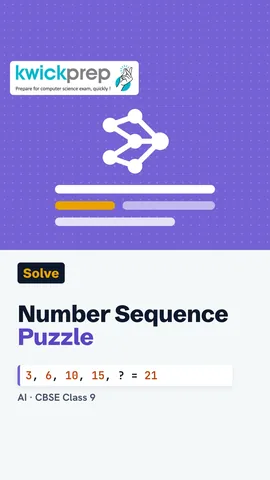 What comes after 3, 6, 10, 15?41 sec
 Pentagon is to what?43 sec
 How many examples does a machine see?41 sec
The full lesson, in text
Hello students, welcome to Kwickprep. Two, four, eight, sixteen. What comes next? If you said thirty two, you just did what AI does all day. Today we learn why patterns sit at the heart of AI. We solve number and picture puzzles, and connect them to machine learning.
First, what is a pattern? A pattern is something that repeats, or changes by a fixed rule. We find patterns in numbers, shapes, sounds and even words. For example, the days of the week repeat every seven days. Once you know the rule of a pattern, you can predict what comes next.
Why do patterns matter so much in AI? Most modern AI learns rules from data, instead of a person typing every rule. Once it finds a pattern, it can predict new cases. Spam filters, face unlock on phones and weather forecasts all work by spotting patterns. If data has no pattern at all, there is nothing for the AI to learn.
Here is a step by step method for number puzzles. First, find the difference between each pair of neighbouring numbers. Next, ask, are all the differences the same? If yes, the rule is to add that number each time. If no, try other ideas, like multiplying, or square numbers. Then check that your rule works for every term, not just the first two. Finally, use the rule to predict the next term.
Let us solve some puzzles. Five, nine, thirteen, seventeen, what next? Each difference is plus four, so the next number is twenty one. Fifty, forty five, forty, thirty five, what next? Each step is minus five, so the answer is thirty. When the difference stays the same, just add it again.
Some sequences grow too fast for adding. Two, four, eight, sixteen: each number is double the one before, so the next is thirty two. Three, nine, twenty seven: each is three times the last, so the next is eighty one. One thousand, one hundred, ten: each is divided by ten, so the next is one.
Now some trickier ones. One, four, nine, sixteen are the square numbers. Their differences are three, five and seven, odd numbers growing by two, so next is twenty five. Three, six, ten, fifteen: the differences grow by one each time, plus three, plus four, plus five, so next is twenty one. One, one, two, three, five: each number is the sum of the two before it, so next is eight.
Pause and predict. What comes after four, seven, twelve, nineteen, twenty eight? Find the differences first: plus three, plus five, plus seven, plus nine. The differences grow by two, so the next difference is plus eleven. Twenty eight plus eleven gives thirty nine.
Now picture puzzles, called analogies. They are written as A, colon, B, double colon, C, colon, question mark. We read it as, A is to B, as C is to what? First, find what changed from picture A to picture B. Then apply exactly the same change to picture C.
Let us solve three picture puzzles. An empty circle becomes a filled circle, so the change is filling in colour, and an empty square becomes a filled square. An arrow pointing up turns to point right, which is a quarter turn clockwise, so an arrow pointing left turns to point up. A triangle becomes a square, adding one side, so a pentagon becomes a hexagon.
In picture puzzles, only a few kinds of change happen. Rotation means the shape turns, so watch its direction. Size means the shape grows or shrinks. Count means the number of items changes, like two dots becoming three. Colour or fill means empty shapes become shaded. Position means the shape moves, like from left to right.
Now let us connect this to machine learning. You look at a few examples, while a machine learning model looks at thousands, like photos of cats. You guess a rule in your head, while the model adjusts many internal numbers to capture the rule. You check your rule on another term, and the model is tested on new data it has not seen. Finally, both of you predict new cases, like, is this photo a cat?
Patterns can also mislead us. With too few examples, we may pick the wrong rule. For one, two, four, the next could be eight, by doubling, or seven, by adding one more each time. Machines can also find false patterns in small or biased data. That is why AI needs lots of good, varied data to learn the right rule.
Let us revise what we learned today. A pattern is something that repeats or changes by a rule. For number puzzles, check the differences first, then try multiplying or squares. For picture puzzles, find the change from A to B, then apply it to C. AI learns patterns from data so it can predict new cases. And the more good data it has, the better the patterns it finds.
Courses that teach this
| Course | Unit |
|---|---|
| CBSE Class 9 Artificial Intelligence (417) | Part B - Unit 3: Math for AI (Statistics & Probability) |
Free to watch, no sign-up. The live classes are the paid course; these lessons stay free either way.
Disclaimer. KwickAcademy is free study material for general learning and revision. Parts of it, including the voice-over, are produced with the help of AI tools and may contain errors; if you spot one, please tell us and we will correct it. Syllabus, marks and exam details follow the latest official board publications available to us, and boards can change them at any time, so always confirm against your board's official website and your school. Using this material does not guarantee any marks or result. Board names and trademarks belong to their owners; Kwickprep is not affiliated with or endorsed by any examination board. We never ask for passwords, OTPs or ID numbers. Your progress is saved only in this browser. Full disclaimer · Privacy