
KwickAcademy Java · 6 min · free
User-defined Methods in Java
Why methods exist, how to define and call one, signature rules, actual and formal parameters, pass by value, and pure versus impure methods.
Follows the syllabus of: ICSE Class 9 Computer Applications, ICSE Class 10 Computer Applications, ISC Class 12 Computer Science (868)
On screen in this lesson
Why methods?
| A method is a named block of code that does one task |
| Reuse: write once, call it many times |
| Modularity: split a big program into small parts |
| Easier to test, read and correct |
Parts of a method
| Part | In our example | Meaning |
|---|---|---|
| Modifier | static | how it is used |
| Return type | int | type sent back |
| Name | area | what we call it |
| Parameter list | int length, ... | inputs it needs |
| Body | { ... } | the steps |
Signature and return type
| Signature = method name + parameter list |
| Signature of area: area(int, int) |
| Return type is NOT part of the signature |
| void means the method returns nothing |
| return sends a value back and ends the method |
Passing arguments
| Arguments are the values written in the call |
| Number of arguments must match the parameters |
| Types must match or widen, like int to double |
| Order matters: first argument goes to first parameter |
Actual and formal parameters
| Name | Where it appears | Example |
|---|---|---|
| Actual parameter | in the call | bill(3, 15) |
| Formal parameter | in the header | qty, price |
Value vs reference
| Primitives (int, double, char): a copy of the value |
| Arrays and objects: a copy of the reference |
| Changes to the contents are seen by the caller |
| Textbooks call the second case call by reference |
Quick answers
Is the return type part of a method signature?
No. The signature is only the name and the parameter types.
Why did marks stay 50 after add(marks)?
An int is passed as a copy, so changing the parameter does not touch marks.
KwickClips from this lesson
Short clips, one idea each. Good for revision the night before.
 Why use a method?42 sec
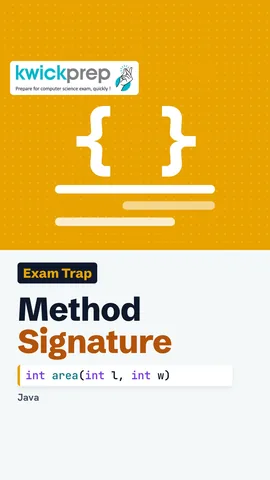 Is the return type part of the signature?41 sec
 What happens if you only define a method?37 sec
 Why did marks not change?40 sec
 What makes a method impure?39 sec
The full lesson, in text
Hello students, welcome to Kwickprep. Suppose you must calculate a canteen bill fifty times in one program. Will you type the same lines fifty times? No. Today we will learn methods, which let you write the steps once and use them again and again.
Let us start with a new term. A method is a named block of code that does one job. Reuse means you write the method once and call it whenever you need it. Modularity means breaking a big program into small parts, like chapters in a book. Small parts are easier to test, read and correct, because each one has a single job.
Here is a method that finds the area of a rectangle. The word static lets us call it without making an object, and we will study it in a later lesson. Int before the name is the return type, the kind of value the method sends back. Area is the method name. Inside the round brackets are the parameters, length and width. The return statement sends the answer back to the caller.
Let us name every part of the first line, called the method header. The modifier, here static, tells Java how the method can be used. The return type, here int, is the type of value sent back. The name is area, and we use it to call the method. The parameter list says what inputs the method needs. The body, inside curly brackets, holds the steps.
Exams often ask about the method signature. The signature is the method name together with the types of its parameters. So the signature of our method is area, int, int. The return type is not part of the signature, so remember this point. If a method sends nothing back, its return type is void. The return statement sends a value back, and the method stops right there.
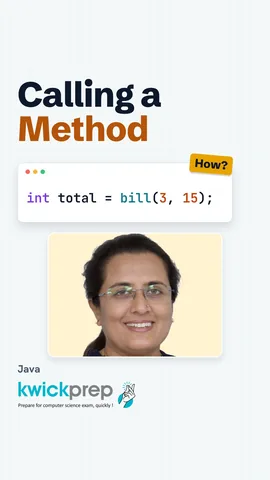
A method does nothing until it is called. Here, bill takes qty, the quantity, and price. Every Java program starts running from main. Inside main, we call bill with three and fifteen, for three samosas at fifteen rupees each. The method returns forty five, and print line shows it on the screen.
The values we send in a call are called arguments. Three rules control them. First, the number of arguments must match the number of parameters. Second, each type must match, or be safely widened, like an int going into a double. Third, the order matters, because the first argument goes to the first parameter, and so on.
Two more exam terms. Actual parameters are the real values written in the method call, like three and fifteen. Formal parameters are the variables in the method header, like qty and price, which receive those values.
When we pass a primitive value, like an int, Java sends a copy. This is called pass by value, or call by value. Here marks is fifty, and add receives a copy in num. The method changes num to sixty, but marks is untouched. So main prints fifty.
Pause and predict. This time marks is an array holding fifty, and the method adds ten to its first box. What prints? It prints sixty. An array is an object, and the variable marks only holds its address, called a reference. The method gets a copy of that address, so it reaches the same array.
Let us sum up the two cases. For primitives like int, double and char, the method gets a copy of the value, so the caller's variable never changes. For arrays and objects, the method gets a copy of the reference. So changes made to the contents are seen by the caller. Many textbooks call this second case call by reference, and strictly, Java always passes a copy.
Methods are also grouped as pure or impure. The state of an object means the values stored in it. A pure method never changes any state, while an impure method does. A pure method always gives the same output for the same input. So a pure method is also called an accessor, and an impure one a mutator. For example, halving a number is pure, but adding money to a balance is impure.
Here bal is the bank balance, one hundred rupees. Half is pure, because it only returns half of its input. Dep, short for deposit, is impure, because it changes bal. Half of one hundred returns fifty, and deposit adds fifty to the balance. So the program prints one hundred fifty.
Let us revise what we learned today. Methods give us reuse and modularity. A signature is the name plus the parameter types, and the return type is not part of it. Actual parameters are in the call, and formal parameters are in the header. Primitives are passed as a copy, but an array's contents can be changed by the method. A pure method changes nothing, while an impure method changes state.
Courses that teach this
| Course | Unit |
|---|---|
| ICSE Class 9 Computer Applications | Working with Methods |
| ICSE Class 10 Computer Applications | User-Defined Methods |
| ISC Class 12 Computer Science (868) | Functions (Methods) |
| Programming All levels Java | Classes, Objects and Methods |
Free to watch, no sign-up. The live classes are the paid course; these lessons stay free either way.
Disclaimer. KwickAcademy is free study material for general learning and revision. Parts of it, including the voice-over, are produced with the help of AI tools and may contain errors; if you spot one, please tell us and we will correct it. Syllabus, marks and exam details follow the latest official board publications available to us, and boards can change them at any time, so always confirm against your board's official website and your school. Using this material does not guarantee any marks or result. Board names and trademarks belong to their owners; Kwickprep is not affiliated with or endorsed by any examination board. We never ask for passwords, OTPs or ID numbers. Your progress is saved only in this browser. Full disclaimer · Privacy