

Java Classes
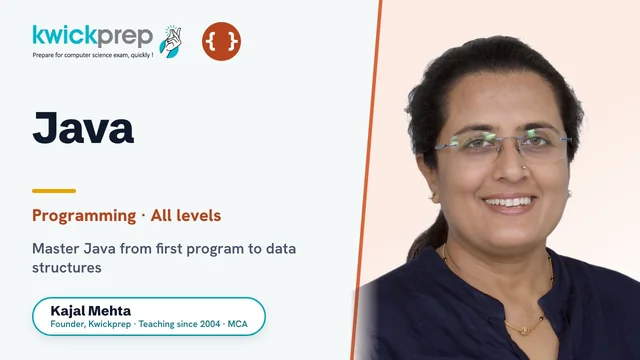
Master Java from first program to data structures the way ICSE and ISC actually teach it.
An all-levels Java programming course built on the official ICSE Computer Applications (Java with BlueJ) and ISC Computer Science syllabi, the boards where Java is the prescribed language. Learners progress from object-oriented fundamentals, classes and methods through inheritance, recursion, and core data structures, writing real programs in BlueJ/JDK at every stage. Note: as a board-agnostic "all levels" track, the curriculum follows the CISCE ICSE/ISC Java syllabus as the authoritative reference, since Oracle Java SE concepts are shared across both.
What you'll learn
- ✓Write, compile and run Java programs in BlueJ and standard JDK environments
- ✓Apply the four pillars of OOP - abstraction, encapsulation, inheritance and polymorphism
- ✓Design classes with constructors, overloaded methods and proper access control
- ✓Manipulate arrays and strings, and implement searching and sorting algorithms
- ✓Build class hierarchies using inheritance, abstract classes and interfaces
- ✓Solve problems using recursion and trace recursive call execution
- ✓Implement core data structures - stacks, queues, linked lists - and use collections like ArrayList
- ✓Plan, code and test a complete real-life Java project for board internal assessment
Full syllabus
Mapped to the official Programming curriculum.
01Object-Oriented Foundations+
- Object-oriented programming paradigm vs procedural
- Principles of OOP: data abstraction, encapsulation, inheritance, polymorphism
- Objects and classes; class as a composite/user-defined data type
- Introduction to Java: applications vs applets, JVM, byte code, compilation process
- Open source concepts and IDEs (BlueJ, NetBeans)
02Java Language Basics+
- Character set, tokens, identifiers, literals
- Keywords, escape sequences, ASCII and Unicode
- Primitive data types and variables
- Type conversion: implicit (coercion) and explicit (casting)
- Operators and expressions; operator precedence and associativity
03Control Flow and Iteration+
- Conditional statements: if, if-else, nested if, switch-case
- Iteration: while, do-while, for loops
- Nested loops
- Jump statements: break and continue
- Building menu-driven and pattern programs
04Classes, Objects and Methods+
- Defining classes, instance variables and methods
- Constructors: default and parameterised; constructor overloading
- Access specifiers and encapsulation (private data, public accessors)
- User-defined methods; pure and impure methods; method overloading
- Passing parameters: call by value and call by reference; the this keyword
- Static (class) variables and methods
05Arrays and Strings+
- Single and double dimensional arrays
- Array traversal, searching (linear, binary) and sorting (selection, bubble)
- String class and common methods: length, charAt, substring, indexOf, concat, replace, compareTo, equals
- StringBuffer basics; manipulating and comparing strings
- Wrapper classes, autoboxing and unboxing
06Inheritance and Polymorphism+
- Base (super) and derived classes; extends keyword
- Member access in derived classes; protected visibility
- super keyword; redefinition and method overriding
- Abstract classes and abstract methods; the Object class
- Single and multilevel inheritance; runtime polymorphism
- Interfaces and multiple implementation
07Recursion+
- Concept of recursion and the call stack
- Recursive methods: factorial, GCD, Fibonacci, power
- Recursive binary search
- Base case vs recursive case; number-base conversions
08Data Structures and Collections+
- Stacks, queues and dequeues; implementation via classes
- Defining data structures through interfaces with multiple implementations
- Singly linked lists: algorithm and implementation
- Binary trees and tree traversals (conceptual)
- ArrayList and dynamic collections; iterating over collections
09Projects and Exam Practice+
- End-to-end Java project: problem analysis, algorithm, coding and testing
- Lab assignments aligned to ICSE Internal Assessment
- Solved ICSE/ISC model and previous-year papers
- Output prediction and debugging exercises
Tools you'll use
Exam pattern
Modelled on CISCE Java boards. ICSE Computer Applications: 100-mark theory paper (Section A 40 compulsory + Section B 60 with choice) plus 100-mark Internal Assessment (lab assignments + project, marked 50 internal / 50 external). ISC Computer Science: Theory 70 marks + Practical 30 marks.
Practical / project
Hands-on lab work in BlueJ (v5.4.2+ with JDK 11+) or any JDK-compatible IDE. Mirrors the ICSE Internal Assessment requirement of 20+ laboratory assignments across the year plus one real-life project, and the ISC practical paper where students design, code, and test working Java programs (problem analysis, algorithm, source listing, output).
Who it's for
School students (ICSE Class 9-10 Computer Applications, ISC Class 11-12 Computer Science) and any beginner-to-intermediate learner who wants a structured, board-aligned path to learning Java and object-oriented programming.
What's included
- ✓Live, interactive online Java classes with shared-screen coding in BlueJ and standard JDK
- ✓Available in both small Group batch and One-to-One mode (fees differ by mode)
- ✓Kwick Notes covering OOP concepts, syntax, and program logic, chapter by chapter
- ✓Worked solutions to ICSE Computer Applications and ISC Computer Science textbook and board questions
- ✓Graded coding assignments and lab exercises mirroring the ICSE Internal Assessment workload
- ✓Regular doubt-solving sessions plus output-prediction and debugging drills
- ✓Board and practical paper practice with previous-year and model question papers
- ✓Step-by-step project guidance for the ICSE/ISC internal assessment project, including viva preparation
Why study Java?
Java is the prescribed programming language for CISCE boards: ICSE Computer Applications (Class 9-10) and ISC Computer Science (Class 11-12), where it carries heavy weightage across a full theory paper plus a 100-mark internal assessment or practical paper. Learning Java properly at school level builds the object-oriented thinking that nearly every later programming course assumes, so the foundation pays off well beyond the board exam. Because Computer Applications and Computer Science are highly scoring subjects when the logic is genuinely understood, structured Java coaching can lift the overall percentage meaningfully. Beyond marks, Java remains one of the world's top-three languages, so the concepts learned here stay directly useful into college and a tech career.
Java consistently ranks among the top three programming languages worldwide and is the backbone of Android apps, banking and enterprise systems, and large-scale backend services. The object-oriented foundation built in this course maps directly onto engineering and BCA/MCA/B.Sc CS coursework, data structures, and the standard hiring interviews for software roles. For a student aiming at computer science, IT, or any software career, fluency in Java is a genuine head start rather than a throwaway school skill.

Learn directly from Kajal Ma'am
An MCA who has taught computer subjects since 2004, Kajal Mehta personally mentors every batch, turning dense theory into clear, exam-ready understanding.
The Kwickprep Method
Computer subjects are not learnt by memorising code. Since 2006, Kajal Ma'am has taught Java with one simple loop that turns logic into marks:
Concept in plain words
Every topic starts from why it exists and what problem it solves, before any code.
Worked through live with you
Kajal Ma'am writes and runs it on a shared screen, so you see it work, not just read it.
Board-pattern practice
You solve the exact question types that repeat in your board's paper, section by section.
Doubts till it clicks
Ask anything, any time in the live class. Nothing moves on until the concept is clear.
Exam & practical drill
Full papers, the practical file, the project and viva, rehearsed until you walk in confident.
Where this takes you
This is not just a subject to clear, it is a skill that carries forward:
- →Java runs Android apps, banking systems and enterprise backends.
- →Object-oriented design used across the whole software industry.
- →Interview-ready fundamentals the language most asked in placements.
It is a direct path to Android, backend and enterprise software careers. We teach for the board first, and for the thinking that lasts after it.
What students say
“I joined the CS40+ course in January 2023, and it was completed within the mentioned time. I found the course very effective and well-organized. The teaching method and study material are up to the mark. I learned new things, and rather than mugging up the code, I learned to develop logic.”
“I have enrolled in the Kwick Revision course, which is designed for 10 days. They have covered all the topics in meticulous time. The teaching method was good. Study materials and course content were up to the mark. Educators resolved doubts within the committed time only.”
“Thank you so much ma'am for believing in me and teaching me so well that i developed interest in computer science. i'll always be grateful for the help you've done. i'll surely miss our classes. Take care of your health ma'am. Once again Thanks a lot ma'am.”
Read all 36 verified student & parent reviews (4.9/5) or see the board results.
Course FAQs
Are the Java classes live or recorded?+
Is the course online, and can students outside India join?+
Do you offer one-to-one classes or only group batches?+
Which board syllabus does this Java course follow?+
Do you help with the practical exam and internal assessment project?+
Can I see a class before paying?+
Related courses
What students & parents say
4.9/5 from 36 verified student & parent reviews. Below are three, unedited.
I was able to complete entire syllabus in short duration while preparing for conpetitive exams. Best way to cover entire syllabus. Highly satisfied with teaching method.
I'm deeply appreciative of your guidance, ma'am. The way you covered the syllabus so thoroughly and on time, along with the ample practice questions and sample papers, was instrumental in our preparation. Your classes are not only enjoyable but a true highlight-your interactive approach makes learning a delight. What sets you apart is your dedication and exceptional teaching methods, which are not only appreciated but deeply impactful. You have a unique ability to simplify complex concepts, making you an exemplary educator. Thank you for your unwavering commitment to our success.
My experience with Kwickprep was truly amazing. The course quality, teaching style, and study materials were all excellent, everything was taught in a very clear and organized way. What I found most valuable was the systematic and easy-to-follow teaching method. It really helped me take better notes during class and made revision much simpler. The entire course was completed on time, just as planned, which gave me enough space to revise thoroughly and solve sample papers without any rush. I also really appreciated how responsive the educators were, I always got replies within the promised time whenever I had any doubts. Overall, it was completely worth it, and I'm really happy with the way everything was handled. Thank you, Kwickprep!
Book a free demo for Java
See a real class before you decide. No pressure, no payment.
Book Free Demo on WhatsApp