

C++ Classes
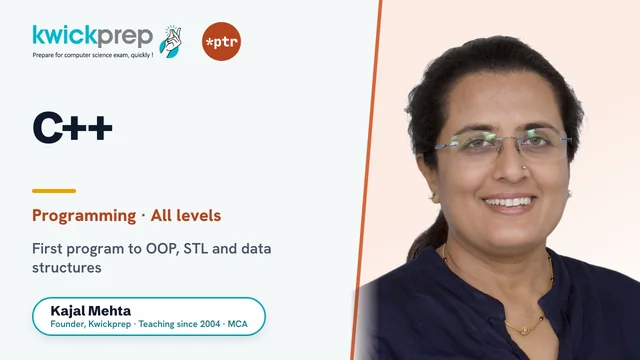
Master C++ from first program to OOP, STL and data-structure fundamentals.
A structured, all-levels C++ programming course that takes learners from core syntax to object-oriented design, the Standard Template Library (STL), and the fundamentals of data structures and algorithms. The curriculum follows widely used industry and academic C++ learning paths (the C++ standard and widely used academic learning paths) since this is a general skills course rather than a single examination board's syllabus. Ideal for school and early-college students building a strong programming foundation and preparing for computer science coursework or competitive programming.
What you'll learn
- ✓Write, compile and debug C++ programs using correct syntax and standard I/O
- ✓Apply control structures, functions and recursion to solve programming problems
- ✓Work confidently with arrays, strings, pointers and dynamic memory
- ✓Design object-oriented solutions using classes, inheritance and polymorphism
- ✓Use templates, exception handling and file handling for real-world programs
- ✓Use the STL containers, iterators and algorithms to manage data efficiently
- ✓Implement and reason about fundamental data structures and Big-O complexity
- ✓Build small projects that combine OOP, STL and file handling
Full syllabus
Mapped to the official Programming curriculum.
01Unit 1: C++ Foundations+
- Setting up a compiler and IDE; structure of a C++ program
- Tokens, keywords, identifiers and comments
- Variables, data types and the const qualifier
- Input/output with cin and cout; namespaces
- Operators: arithmetic, relational, logical, bitwise and assignment
- Type conversion and type casting
02Unit 2: Control Flow and Functions+
- Conditional statements: if, if-else, nested if, switch
- Loops: for, while, do-while; break and continue
- Defining and calling functions; parameters and return values
- Call by value vs call by reference
- Function overloading and default arguments
- Scope, storage classes and recursion
03Unit 3: Arrays, Strings and Pointers+
- One-dimensional and multi-dimensional arrays
- C-style strings and the std::string class
- Pointers and pointer arithmetic; references
- Dynamic memory allocation with new and delete
- Stack vs heap memory
- Structures (struct) and enumerations
04Unit 4: Object-Oriented Programming+
- Classes and objects; data members and member functions
- Access specifiers: public, private, protected; encapsulation
- Constructors, destructors and the this pointer
- Inheritance: single, multiple, multilevel and hierarchical
- Polymorphism: function and operator overloading, virtual functions
- Abstraction and abstract classes
05Unit 5: Templates, Exceptions and File Handling+
- Function templates and class templates (generics)
- Exception handling with try, catch and throw
- File streams: ifstream, ofstream and fstream
- Reading from and writing to text files
- Lambda functions and an introduction to modern C++ features
06Unit 6: STL and Data Structure Fundamentals+
- STL overview: containers, iterators and algorithms
- Sequence containers: vector, list, deque
- Associative containers: set, map, pair
- Container adapters: stack, queue, priority_queue
- STL algorithms: sort, find, count, binary_search
- DSA basics: linked lists, stacks, queues, searching and sorting; Big-O time complexity
Tools you'll use
Exam pattern
Skills-based course with no fixed external board exam. Progress is assessed through coding assignments, hands-on lab exercises and a capstone project rather than a theory/practical marks split.
Practical / project
Hands-on, lab-driven learning: each unit includes coding exercises and debugging practice, building up to mini-projects (such as a class-based management program and an STL-based data-handling tool) and a final capstone project that applies OOP, STL and file handling.
Who it's for
School students (Class 8 and above) and early-college learners who want a strong, structured C++ foundation for computer science coursework, board CS/IP subjects, or competitive programming.
What's included
- ✓Live, interactive online classes with Kajal Ma'am on a shared screen, with code typed and run in real time
- ✓Kwick Notes for every unit, concept summaries, syntax references and worked C++ examples
- ✓Hands-on coding assignments after each topic, with reviewed solutions
- ✓Lab exercises and debugging practice that build from basics to OOP, STL and file handling
- ✓Unit mini-projects (e.g. a class-based management program, an STL data-handling tool) plus a final capstone project
- ✓Regular one-on-one doubt-solving sessions so no concept is left unclear
- ✓Guidance for school board CS/IP practical exams and viva preparation where the language is C++
- ✓Available in both a small Group batch and a One-to-One mode (different fees)
Why study C++?
C++ is one of the most valuable languages a student can learn because it teaches how programs actually use memory, build objects and structure data, the exact foundation that computer science coursework, board CS/IP practicals and competitive programming all rely on. Unlike higher-level languages that hide these details, C++ forces clear thinking about pointers, classes and complexity, which makes every language learned afterward easier. Because it is taught from first program to OOP, STL and data-structure fundamentals, this course suits complete beginners as well as students who want a serious, scoring foundation for school exams and college entrance into CS. A strong C++ base is one of the most reliable ways to develop genuine problem-solving and coding confidence.
C++ remains heavily used in performance-critical fields such as systems and embedded programming, game and game-engine development, high-frequency trading and finance, and parts of AI and high-performance computing. Strong command of C++ together with data structures and algorithms is also what most technical interviews and competitive-programming contests test, making it a practical base for a computer science degree or a software engineering career. The course builds that DSA-and-OOP foundation without overpromising any specific job outcome.

Learn directly from Kajal Ma'am
An MCA who has taught computer subjects since 2004, Kajal Mehta personally mentors every batch, turning dense theory into clear, exam-ready understanding.
The Kwickprep Method
Computer subjects are not learnt by memorising code. Since 2006, Kajal Ma'am has taught C++ with one simple loop that turns logic into marks:
Concept in plain words
Every topic starts from why it exists and what problem it solves, before any code.
Worked through live with you
Kajal Ma'am writes and runs it on a shared screen, so you see it work, not just read it.
Board-pattern practice
You solve the exact question types that repeat in your board's paper, section by section.
Doubts till it clicks
Ask anything, any time in the live class. Nothing moves on until the concept is clear.
Exam & practical drill
Full papers, the practical file, the project and viva, rehearsed until you walk in confident.
Where this takes you
This is not just a subject to clear, it is a skill that carries forward:
- →C++ powers games, high-performance software and systems.
- →Competitive programming & DSA the language contests are won in.
- →Speed and control most other languages simply can't match.
It is ideal for competitive coding, game development and a rock-solid CS foundation. We teach for the board first, and for the thinking that lasts after it.
What students say
“Learning with kwickprep has been a wonderful experience. It has a very user friendly interface and is aesthetically pleasing. It provides all the important points and the proper explanation of the topics without prevaricating from the original topic.”
“My experience with Kwickprep was good. They guided me well for the Boards. That's why I would recommend Computer Science Aspirants to join Kwickprep, as their teaching and study material is the best among all others. Kwickprep is the best choice for classes 11 and 12.”
“I have joined kwick revision course before board examination. It found very useful for preparation of board examination. Educator cover all the topics. Investment of time was worth. Study material and sample paper practice were well organised.”
Read all 36 verified student & parent reviews (4.9/5) or see the board results.
Course FAQs
Are the C++ classes live or recorded?+
Is this course for complete beginners or also for advanced students?+
Do you offer Group batches and One-to-One classes, and how do the fees differ?+
Is this C++ course tied to a specific board syllabus?+
Can you help with my school's C++ practical exam and project?+
Can I attend a demo class before joining?+
Related courses
C Language
Learn C from first program to pointers, structures, and files, the foundation of all mode
Python
Learn Python from first principles to real projects, beginner to confident coder.
Java
Master Java from first program to data structures the way ICSE and ISC actually teach it.
What students & parents say
4.9/5 from 36 verified student & parent reviews. Below are three, unedited.
Before joining Kwickprep, I honestly struggled a lot with Computer Science. I couldn't understand most of the concepts, but thanks to Kajal Ma'am, that completely changed. Her teaching helped me improve so much, and I'm really grateful for that. She's one of the best teachers I've ever had. She explains everything with so much clarity and patience, and even if I didn't understand something the first time, she would happily explain it again, as many times as needed. Yes, sometimes she got strict, but I know it was always for our own good. What I appreciated most was the way she helped us solve a variety of question papers during the Kwick Revision sessions. That really boosted my confidence. The course overall was great, the materials, the teaching, and the support. I'm quite satisfied with everything. Thank you, Kajal Ma'am and Kwickprep, for helping me grow in a subject I once found impossible!
I'm deeply impressed by the supportive environment fostered by Kajal Ma'am during the Kwickrevision workshop. Her approach not only facilitates a thorough understanding of the subject matter but also encourages a collaborative and nurturing learning experience. This workshop stands out as one of the best I've ever attended, and I attribute much of that to Kajal Ma'am's exceptional guidance.
Learning with kwickprep has been a wonderful experience. It has a very user friendly interface and is aesthetically pleasing. It provides all the important points and the proper explanation of the topics without prevaricating from the original topic.
Book a free demo for C++
See a real class before you decide. No pressure, no payment.
Book Free Demo on WhatsApp