

CBSE Class 11 Informatics Practices (IP) Classes
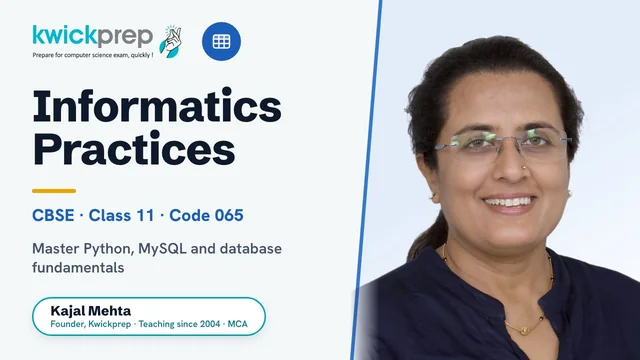
Master Python, MySQL and database fundamentals for the CBSE Class 11 IP (065) board exam.
A complete, syllabus-aligned course for CBSE Class 11 Informatics Practices (Code 065) for the 2026-27 academic year. Covers computer systems, Python programming with NumPy, relational databases and SQL using MySQL, and emerging technology trends, with structured practical work to prepare for the 70-mark theory and 30-mark practical assessment. Built directly from the official CBSE curriculum.
What you'll learn
- ✓Identify and explain the components of a computer system, memory types, and software categories
- ✓Write Python programs using variables, operators, data types, and control statements (if-elif-else, while, for)
- ✓Manipulate lists and dictionaries using built-in methods and functions
- ✓Create NumPy arrays and understand basic array handling
- ✓Design relational database tables and apply primary, candidate, and alternate keys
- ✓Write SQL queries in MySQL using DDL, DQL, and DML commands (CREATE, ALTER, SELECT, INSERT, UPDATE, DELETE)
- ✓Filter and retrieve data with WHERE, BETWEEN, relational and logical operators, and NULL checks
- ✓Describe emerging technologies including AI, IoT, Big Data, Cloud Computing, and Blockchain
Full syllabus
Mapped to the official CBSE curriculum.
01Unit 1: Introduction to Computer System (10 marks)+
- Introduction to computer and computing: evolution of computing devices
- Components of a computer system and their interconnections
- Input/output devices
- Computer Memory: units of memory, primary and secondary memory
- Data deletion, its recovery and related security concerns
- Software: purpose and types - system and application software
- Generic and specific purpose software
02Unit 2: Introduction to Python (25 marks)+
- Basics of Python programming; interactive and script execution modes
- Structure of a program, indentation, identifiers, keywords, constants, variables
- Types of operators and precedence of operators
- Data types, mutable and immutable data types, statements and expression evaluation
- Comments, input and output statements, data type conversion, debugging
- Control statements: if-else, if-elif-else, while loop, for loop
- Lists: creating, initializing, traversing and manipulating; list methods and built-in functions - len(), list(), append(), insert(), count(), index(), remove(), pop(), reverse(), sort(), min(), max(), sum()
- Dictionaries: key-value pairs, creating, initializing, traversing, updating, deleting; methods - dict(), len(), keys(), values(), items(), update(), del(), clear()
- Introduction to NumPy: creation of NumPy arrays from a list
03Unit 3: Database Concepts and the Structured Query Language (30 marks)+
- Introduction to database concepts and its need; Database Management System
- Relational data model: domain, tuple, relation, candidate key, primary key, alternate key
- Advantages of SQL; DDL, DQL and DML
- Introduction to MySQL; creating a database; data types
- Data Definition: CREATE DATABASE, CREATE TABLE, DROP, ALTER
- Data Query: SELECT, FROM, WHERE with relational operators, BETWEEN, logical operators, IS NULL, IS NOT NULL
- Data Manipulation: INSERT, DELETE, UPDATE
04Unit 4: Introduction to Emerging Trends (5 marks)+
- Artificial Intelligence, Machine Learning, Natural Language Processing
- Immersive experience (AR, VR), Robotics
- Big Data and its characteristics, Internet of Things (IoT), Sensors, Smart cities
- Cloud Computing and Cloud Services (SaaS, IaaS, PaaS)
- Grid Computing, Blockchain technology
Tools you'll use
Exam pattern
Total 100 marks: Theory 70 marks (Unit 1: 10, Unit 2: 25, Unit 3: 30, Unit 4: 5) + Practical 30 marks.
Practical / project
Practical component carries 30 marks: Problem solving using Python (11), Creating a database in MySQL and performing queries (7), Practical file with a minimum of 14 Python programs and 14 SQL queries (7), and Viva-Voce (5). Suggested practicals include average/grade calculators, interest and EMI/GST computations, list and dictionary problems, and SQL tasks such as creating a student table, inserting records, and filtering by marks or date ranges.
Who it's for
CBSE Class 11 students taking Informatics Practices (Code 065) who want a structured, board-aligned path through Python, databases, and SQL ahead of their theory and practical exams.
What's included
- ✓Live interactive online classes with Kajal Ma'am, available in both group batch and personalised one-to-one formats
- ✓Chapter-wise handwritten and typed notes covering the full CBSE 065 syllabus (Computer Systems, Data Handling with Pandas/NumPy, Data Visualisation, Database Concepts and SQL, Emerging Technologies and Societal Impacts)
- ✓NCERT textbook and exercise solutions explained step by step
- ✓Topic-wise assignments and worksheets after each chapter to reinforce learning
- ✓Regular live doubt-solving sessions so no question goes unanswered
- ✓Board pattern paper practice (70-mark theory) with VSA, SA-I, SA-II and Long Answer question drilling
- ✓Guided practical-file preparation for the 30-mark internal/practical assessment, including Python and SQL output work
- ✓Project guidance and viva preparation for the practical exam
Why study Informatics Practices?
CBSE Class 11 Informatics Practices (Subject Code 065) is the foundation year for the more demanding Class 12 board syllabus, so a clear start here directly protects your final score. The subject is highly scoring because Python data handling with Pandas/NumPy and SQL queries carry the bulk of the 70-mark theory paper, and these are skill-based topics that reward practice over rote learning. With 30 marks reserved for practicals, students who build genuine coding and database understanding in Class 11 routinely top the subject. For commerce and humanities students especially, IP delivers real, usable data and computing skills without the heavier algorithmic load of Computer Science.
The Pandas, NumPy and SQL skills introduced in IP Class 11 are the same tools used in data analytics, business intelligence and data science roles, making the subject a strong early on-ramp for BCA, BBA-Analytics, B.Com (Data), and B.Sc Data Science / IT degrees. It also gives commerce and management students practical computing literacy that is increasingly expected in finance, marketing analytics and operations. Students aiming for full software or engineering careers can use it alongside or as a stepping stone toward Computer Science.

Learn directly from Kajal Ma'am
An MCA who has taught computer subjects since 2004, Kajal Mehta personally mentors every batch, turning dense theory into clear, exam-ready understanding.
The Kwickprep Method
Computer subjects are not learnt by memorising code. Since 2006, Kajal Ma'am has taught CBSE Class 11 Informatics Practices (IP) with one simple loop that turns logic into marks:
Concept in plain words
Every topic starts from why it exists and what problem it solves, before any code.
Worked through live with you
Kajal Ma'am writes and runs it on a shared screen, so you see it work, not just read it.
Board-pattern practice
You solve the exact question types that repeat in your board's paper, section by section.
Doubts till it clicks
Ask anything, any time in the live class. Nothing moves on until the concept is clear.
Exam & practical drill
Full papers, the practical file, the project and viva, rehearsed until you walk in confident.
Where this takes you
This is not just a subject to clear, it is a skill that carries forward:
- →Python with Pandas the core skill of every data analyst.
- →SQL the language behind every database and dashboard.
- →Data visualization turning numbers into charts businesses act on.
It opens BBA and B.Com with analytics, data science and BCA, a strong bridge between commerce and technology. We teach for the board first, and for the thinking that lasts after it.
What students say
“I have enrolled in the Kwick Revision course, which is designed for 10 days. They have covered all the topics in meticulous time. The teaching method was good. Study materials and course content were up to the mark. Educators resolved doubts within the committed time only.”
“Thank you so much ma'am for believing in me and teaching me so well that i developed interest in computer science. i'll always be grateful for the help you've done. i'll surely miss our classes. Take care of your health ma'am. Once again Thanks a lot ma'am.”
“The course's greatest benefit for me was the profound comprehension of the core principles it fostered, which has been pivotal in enhancing my academic foundation.”
Read all 36 verified student & parent reviews (4.9/5) or see the board results.
Course FAQs
Are the Informatics Practices Class 11 classes live or recorded?+
Do you offer both group batches and one-to-one classes for IP Class 11?+
Who can join this online IP Class 11 course?+
Is the course aligned with the latest CBSE 2026-27 syllabus?+
Will you help with the practical exam and project?+
Can I get a demo class before enrolling?+
Related courses
Computer Applications
Master computer fundamentals, cyber safety, and office tools for CBSE Class 9 Computer App
Computer Applications
Master web design with HTML, CSS, networking and cyber ethics for the CBSE Class 10 Comput
Computer Science
Master Python programming and computational thinking with the official CBSE Class 11 Compu
Free guides for this subject
CBSE Class 11 Informatics Practices Practical File, Python and SQL with Output
Free CBSE Class 11 Informatics Practices (065) practical file programs — Python basics, pandas Series and DataFrames, an
Open →Free resourceCBSE Class 11 Informatics Practices Syllabus 2026-27
Download the official CBSE Class 11 Informatics Practices (065) syllabus 2026-27 — unit-wise topics, marks weightage, an
Open →CBSE · Class 11 · Informatics PracticesCBSE Class 11 Informatics Practices, Chapter-wise Weightage 2026-27
CBSE Class 11 Informatics Practices chapter-wise weightage for 2026-27: unit-wise marks table for all 4 units (70 theory
Open →What students & parents say
4.9/5 from 36 verified student & parent reviews. Below are three, unedited.
My experience with Kwickprep has been amazing. The course quality, teaching style, and study materials were all top-notch, definitely deserving of five stars. Everything was explained clearly, and the methods used made learning both easy and effective. One thing I truly appreciated was how responsive the educators were. I always received support within the promised time, which made me feel supported throughout the course. What stood out the most for me was the question bank and notes available on the website, they were extremely helpful for my preparation. Overall, it was completely worth it, and I'm really glad I chose Kwickprep for my studies!
I have enrolled in the Kwick Revision course, which is designed for 10 days. They have covered all the topics in meticulous time. The teaching method was good. Study materials and course content were up to the mark. Educators resolved doubts within the committed time only.
I was also preparing for my JEE entrance exam. I thought that I was not able to complete the syllabus in a short period of time, but as per the commitment, the course has been completed, and I got a thorough revision too, which was quite useful. The Kwickprep course, study material, and quality of teaching were good. I got support during my practical examination. Doubt solving took place in very less time. I am satisfied with the course.
Book a free demo for Informatics Practices
See a real class before you decide. No pressure, no payment.
Book Free Demo on WhatsApp